

Walk into a plastics factory and the first thing you notice is rhythm. Machines open, close, inject and release, over and over, and the whole operation depends on that beat staying steady. If one step slows down, the entire line feels it.
At the centre of this process sits the automatic injection molding machine, which melts plastic and shapes it inside a mold. But the machine is only part of the story. Once a part is formed and cooled, something has to take it out of the mold and put it somewhere useful. In many modern plants, that something is a robot.
The cycle in plain terms
Injection molding follows a simple sequence. The mold closes, molten plastic is injected, the plastic cools and hardens, the mold opens, and the finished part is removed. Then it all starts again. The time this takes is called the cycle time, and shaving even a fraction of a second from the parts that are not the actual molding, like removing the part, can add up over thousands of repetitions.
A take-out robot handles that removal step. It reaches into the open mold, grips the part, pulls it out and places it on a conveyor, in a cooling station or at an inspection point. Done by hand, the same job depends on how quickly and consistently a person can work, and it brings an operator close to the moving mold.
What the Samfacc SFK-WD series offers
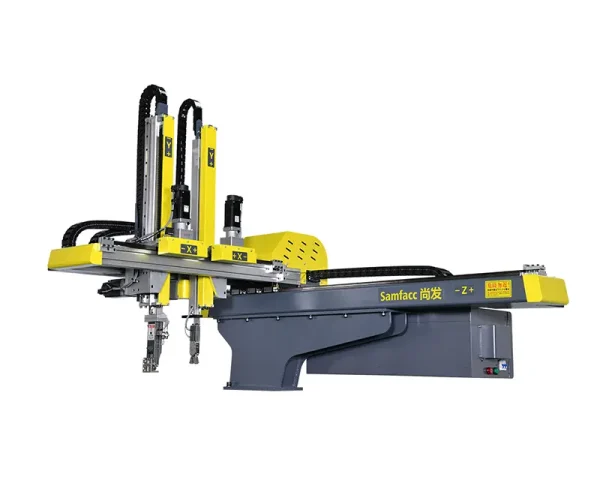
Foshan Samfacc Robot Co., Ltd, based in Guangdong, China, makes a range of robots for the injection molding industry. One of them is the high-speed SFK-WD series, which the company describes as a 3 to 5 axis servo injection molding robot with a double arm and a frame structure.
According to the product page, the series is designed for injection molding machines from 90 to 400 tons and for production cycles between 3 and 10 seconds. The manufacturer states that the fastest cycle time of its high-speed SFK series can reach 2.8 seconds, with a take-out time of 0.6 seconds. The page also lists ISO9001 and CE certification.
Why servo drive and a rigid frame matter
The robot is driven by servo motors, which the manufacturer says supports operating speed and smooth control. The frame-type structure is described as providing rigidity and stability during continuous high-speed work, which the company says reduces vibration and mechanical deformation and helps positioning accuracy.
The double stage arm uses a belt double speed principle. According to the manufacturer, this raises running speed and also lowers the requirement for workshop height, which can matter in a factory with a limited ceiling.
Handling stack molds and complex parts
The double arm design suits stack mold products, and the page notes that it is intended to save cycle time. Stack molds produce parts on more than one level at the same time, so the robot has to reach several positions accurately in each cycle. The 5-axis servo version is described as offering more motion flexibility for stacked molds, complex take-out angles and precise placement.
Where it is used
The company lists electronics, household appliance products, medical products, and knives and forks made with stack molds as suitable applications. For electronics, the page mentions careful handling of small, thin-wall parts. For appliances, it refers to medium and large plastic housings. For medical and industrial products, it talks about clean and consistent handling.
Easier for the people who run it
Not every factory has robotics specialists on staff, so ease of use counts. The manufacturer says the system has touch-screen operation, with manuals and video guidance, and that operators can learn it in as little as half a day. It also lists 100 sets of mold memory, 18 groups of standard programs and 80 groups of user education programs, which means previously used setups can be recalled rather than built again.
A realistic view
A robot does not fix a badly planned production line. It needs to match the machine tonnage, the mold, the part and the cycle you are aiming for. The numbers above come from the manufacturer’s own page, so anyone planning a purchase should confirm them for their specific machine and ask for a demonstration or a reference from a similar application.
Used well, though, a take-out robot gives a line something valuable: consistency. The same movement, at the same speed, cycle after cycle. In a process built on rhythm, that steady repetition is exactly what you want.