

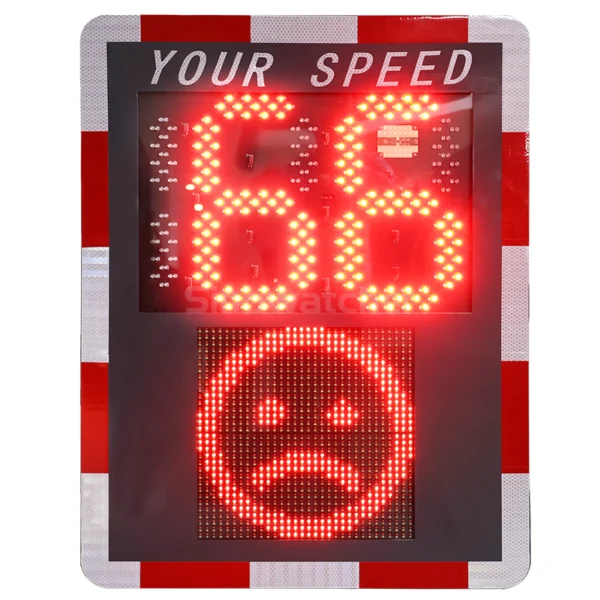
Most drivers believe they know how fast they are going. In reality, speed is easy to misjudge. After a long stretch of open highway, 50 km/h can feel painfully slow. On a quiet residential street, 60 km/h can feel perfectly normal, even though a child could step out at any moment. A roadside display that shows each driver their real speed in large, clear numbers solves this problem in a simple and friendly way.
This article explains how that technology works, why it influences driver behavior, and what its limits are, so that road authorities, schools, contractors and community groups can use it wisely.
Why speed matters so much
Speed is one of the most important risk factors in road safety. The World Health Organization identifies it as a key factor in both the likelihood of a crash and how serious the injuries are when one happens. The reason is basic physics. A moving vehicle’s kinetic energy rises with the square of its speed, so even a small increase produces a much larger impact in a collision. Higher speed also lengthens the distance needed to stop and shortens the time a driver has to react.
That is why speed management is a priority around schools, work zones, residential streets and junctions, where pedestrians and vehicles share the same space.
What a radar speed display actually does
A vehicle speed sign combines two parts: a radar sensor and an LED display. The radar measures the speed of an approaching vehicle, and the display shows the result to the driver almost instantly.
The radar works on the Doppler principle. The sensor sends out radio waves and listens for the waves reflected back from a moving vehicle. When a vehicle is approaching, the returning waves have a slightly higher frequency than the ones sent out, and the size of that change depends on the vehicle’s speed. The device converts the change into a speed reading. The product page for Sinowatcher’s Radar Speed Sign with Driver Feedback states that it uses a 24.125 GHz Doppler radar and detects speeds from 10 to 250 km/h, with a standard detection distance of 100 meters and options for 150 or 200 meters.
One technical detail is worth knowing. Radar measures the speed along its own line of sight, so if the sensor is aimed at a sharp angle to the road, it will read slightly lower than the true speed. Correct installation and alignment are therefore important for accurate readings.
Why feedback changes behavior
The most effective part of the sign is not the radar but the message. Drivers who see their speed in bright numbers receive immediate, personal information. Many slow down simply because they were unaware they were over the limit.
Color and symbols strengthen the message. According to the manufacturer, when the detected speed passes the set threshold, the display changes from green to red and shows a warning symbol, while speeds within the limit appear in green with a positive symbol. This is a clear signal that needs no reading skills or translation, which is helpful on roads used by many different drivers.
There is also a social side. A display is not a fine or a punishment. It is a gentle reminder, and most people respond better to a reminder than to a penalty.
What the evidence says, and what it does not
Traffic authorities in many countries use speed feedback signs, and local studies commonly report lower average speeds near them. It is important to be honest about the limits, however. The effect is usually strongest close to the sign, and it may weaken if drivers become used to a sign that stays in one place for a long time, or if nothing else on the road encourages slower speeds. For this reason, speed feedback signs work best as part of a wider approach that includes sensible road design, clear speed limit signs, public education and, where appropriate, enforcement. They are a supporting tool, not a complete solution.
Extra benefits beyond the display
Modern units also record data. The product page says the sign can log speed data locally, and that the recorded data can be exported for traffic monitoring and road safety analysis. This is valuable because it replaces guesswork with facts. An authority can see at what times speeding happens, how fast the fastest vehicles travel and whether speeds improve after the sign is installed.
Power flexibility is another advantage. The same page lists solar powered DC operation, with external DC power as an optional configuration, so a sign can work in places where mains electricity is not available.
Final thoughts
A speed feedback display does one simple thing very well: it makes drivers aware of their own behavior at exactly the moment it matters. Understanding how the radar works, why feedback changes habits and where the limits lie helps you use the technology realistically. Combined with good road design and community awareness, it can contribute to calmer streets and safer journeys for everyone, especially for the pedestrians who have no protection except the care of the people driving past them.