

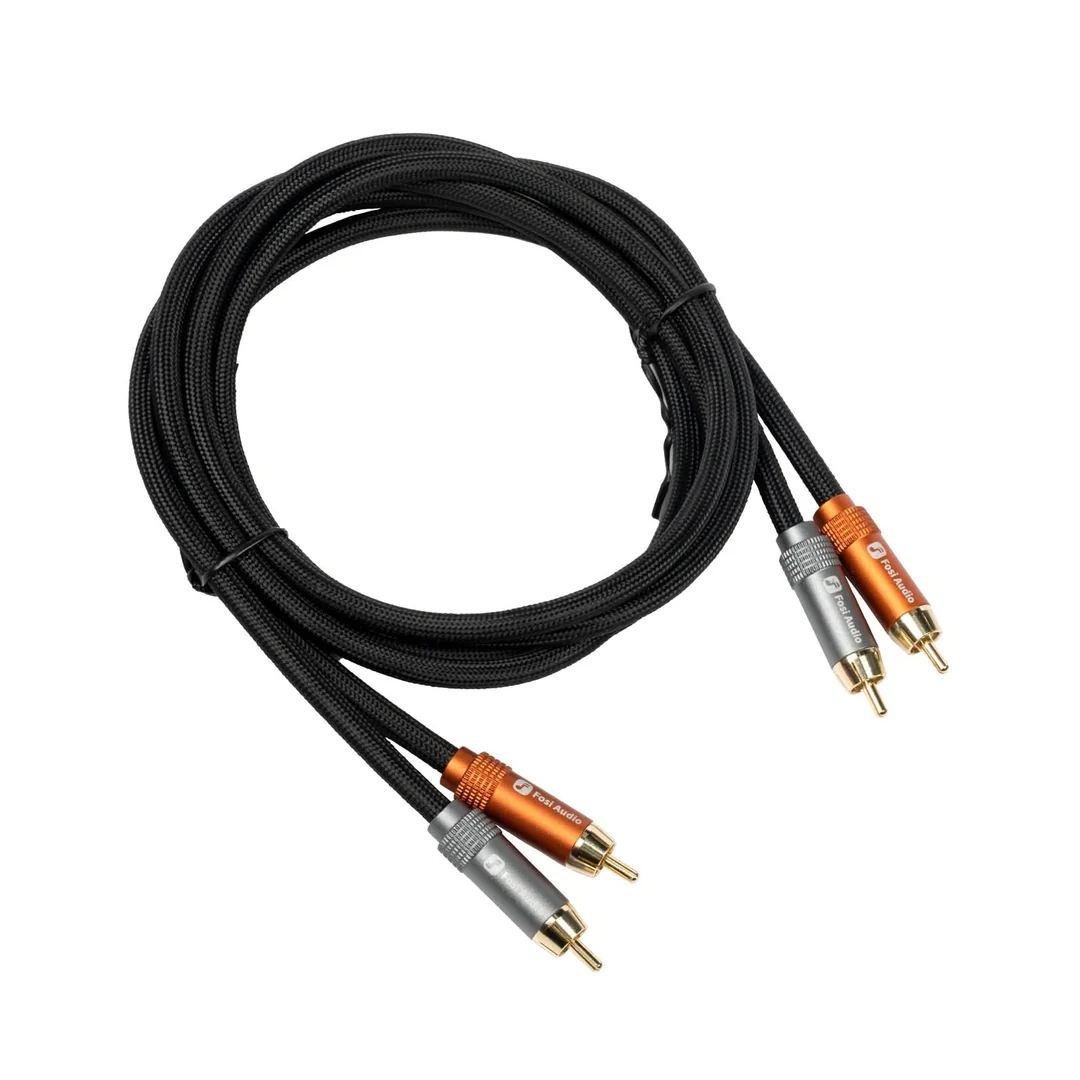
Ask ten people which speaker cable to buy and you will hear ten confident answers, most of them built on adjectives. Ask what a cable actually does to the signal and the answer gets short, because the physics is short. A speaker cable is a pair of copper conductors with a resistance, and that resistance sits in series with the speaker. Everything else is detail. Whether you are choosing an audio and power cable set for a compact desktop system or planning a longer run across a living room, the numbers below tell you more than any product description.
The one calculation that matters
Copper conductors have a known resistance per length, set by their American Wire Gauge (AWG) size. At 20 °C, standard tables give roughly these values:
| AWG | Ohms per 1,000 ft | Ohms per km |
|---|---|---|
| 18 | 6.385 | 20.9 |
| 16 | 4.016 | 13.2 |
| 14 | 2.525 | 8.28 |
| 12 | 1.588 | 5.21 |
Current flows out along one conductor and back along the other, so the resistance that counts is for twice the physical length. A 10 metre run of 16 AWG therefore behaves like 20 metres of wire, or about 0.26 Ω. That resistance and the speaker's own impedance share the amplifier's output. The fraction of power burned in the cable is simply the cable resistance divided by the total.
What you lose at real lengths
The table below assumes a constant resistive load of 4 Ω or 8 Ω, which is how nominal speaker impedance is usually treated. Values are the share of amplifier power dissipated in the cable.
| One way length | Gauge | Loop resistance | Loss at 8 Ω | Loss at 4 Ω |
|---|---|---|---|---|
| 5 m | 18 AWG | 0.21 Ω | 2.6% | 5.0% |
| 5 m | 16 AWG | 0.13 Ω | 1.6% | 3.2% |
| 10 m | 18 AWG | 0.42 Ω | 5.0% | 9.5% |
| 10 m | 16 AWG | 0.26 Ω | 3.2% | 6.2% |
| 10 m | 14 AWG | 0.17 Ω | 2.0% | 4.0% |
| 25 m | 16 AWG | 0.66 Ω | 7.6% | 14.1% |
| 25 m | 14 AWG | 0.41 Ω | 4.9% | 9.4% |
| 25 m | 12 AWG | 0.26 Ω | 3.2% | 6.1% |
Two patterns stand out. Doubling the length doubles the loss. And a 4 Ω speaker suffers roughly twice the loss of an 8 Ω speaker for the same cable, because the cable's share of the total resistance is larger.
Is a few percent audible?
Power loss in decibels is smaller than it looks. A 10 percent loss of power is about 0.46 dB, which is hard to notice as a change in loudness. The more relevant effect is frequency response. Real speakers do not present a constant 8 Ω. Their impedance rises and falls across the frequency range, and cable resistance interacts with those swings, producing small level changes at certain frequencies. This is why the long standing guideline is to keep total cable resistance below about 5 percent of the speaker's nominal impedance.
Applying that rule gives practical maximum one way lengths for copper conductors:
| Gauge | 8 Ω speaker | 4 Ω speaker |
|---|---|---|
| 18 AWG | about 9.5 m | about 4.8 m |
| 16 AWG | about 15 m | about 7.6 m |
| 14 AWG | about 24 m | about 12 m |
| 12 AWG | about 38 m | about 19 m |
The 16 AWG figure matches a commonly quoted statement that 16 gauge copper has no detectable effect on a typical 8 Ω speaker in runs up to about 50 feet.
What a controlled listening test showed
In 1983, Stereo Review magazine ran a double blind comparison of speaker cables with a panel of listeners. One of the cables was thin 24 AWG wire used over 30 feet. Using the table value of 25.67 Ω per 1,000 ft, that run has a loop resistance of about 1.5 Ω, which would absorb roughly 16 percent of the power at 8 Ω. The panel could distinguish it from heavier cables, and the editors concluded that 24 gauge is too thin at that length. They also noted that with runs of only 6 feet, the differences would probably have disappeared. The result is a useful reminder that audible differences between ordinary cables tend to trace back to measurable resistance, and that gauge and length are the variables worth controlling.
Practical guidance
Short runs, 8 Ω speakers. For distances under about 5 metres, 18 or 16 AWG is perfectly adequate for typical desktop and bookshelf setups.
Low impedance speakers. If your speakers are rated at 4 Ω, step up one gauge size, or shorten the run.
Long runs. Move to 14 or 12 AWG rather than hoping a fancier cable will compensate.
Equal lengths. Use the same length of cable for left and right channels so the two sides lose the same amount.
Terminations. Banana plugs or properly crimped terminals give a secure, low resistance contact. Loose bare strands touching each other or a neighbouring terminal are a common cause of faults.
Overheating is not a concern. At normal listening levels, speaker cables carry modest current, so heating is negligible. Heavy gauge is about resistance, not safety.
Limits of the simple model
This analysis treats the speaker as a pure resistor and ignores the amplifier's output impedance, cable inductance and capacitance. For ordinary home and office systems with cable runs of a few metres, those effects are small compared with resistance. Copper's resistance also rises slightly as it warms, so figures at 20 °C are a good baseline, not an exact prediction.
Common questions
Does a thicker cable make audio louder? Only slightly, and only because less power is lost along the way. The effect is small in short runs.
Is it worth running 12 AWG for a desktop system? Not usually. For runs of a metre or two, the difference between 16 and 12 AWG amounts to a fraction of a percent.
What about different conductor materials? Silver has slightly lower resistivity than copper, but its cost makes a thicker copper cable the practical alternative for the same resistance.
The takeaway
Choosing a speaker cable is a sizing exercise. Measure the distance, note the speaker impedance, and pick the gauge that keeps the loss to a few percent. After that, spend attention on connector quality and tidy routing, which affect reliability far more than any claim of exotic construction.