

Buying educational toys for resale or for a learning programme is different from buying ordinary toys. A product has to be fun enough that children come back to it, and sound enough that adults can trust what it claims. Many buyers learn this the hard way, after a shipment arrives with different specifications from the ones on the website. This guide walks through the practical checks that save money and protect your reputation, using a real product page as a worked example.
Start with what the toy actually teaches
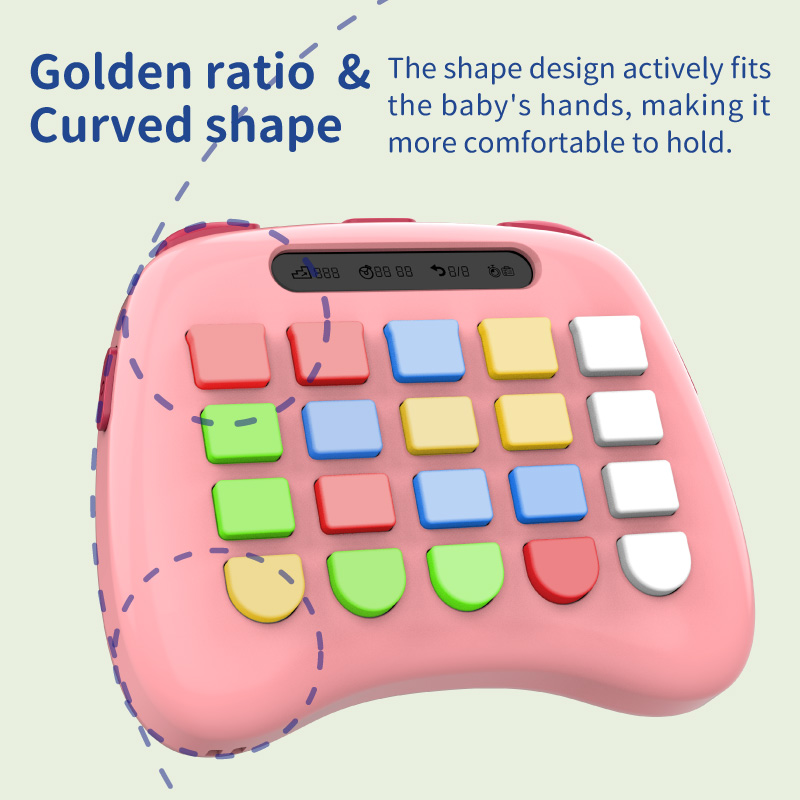
“Educational” is a flexible word, so ask what a toy really practises. Take the DD-02 Colours Decryption Scientific Thinking Machine listed by Smart Tomato Toys. It is a small electronic device, about the size of a pocket game console, measuring 100 x 80 x 25 mm. According to the page, it has four play modes:
- Color Decryption, a colour-sorting puzzle aimed at logical thinking.
- Whack-A-Mole Mania, a reflex game that uses light prompts.
- Color Matching Memory, which practises memory and observation.
- Memory Maze, which works on spatial awareness and sequencing.
The maker lists the skills it targets as logical reasoning, reflexes, memory, observation, spatial awareness, sequential thinking, colour perception, concentration, fine motor skills and creative thinking. Notice how specific this is. A product that names the skill behind each game is easier to explain to parents and teachers than one that simply says “brain training”. That said, these are the maker’s own descriptions, so test the toy with real children before you build your marketing around them.
Read the age range carefully
Age ranges decide who buys the product and what safety rules apply. On this page, the product description gives the range as 3 to 10 years, while the specifications, FAQ and usage steps say 3 to 8. This is a good example of why you should never copy an age range from a website into your own listing without checking. Ask your educational toy supplies partner which figure is correct, and ask for it in writing. Young children, especially under three, need extra care with small parts and batteries, so the stated minimum age matters.
Safety standards: ask for documents, not promises
This is the area where buyers should be most careful. The product page mentions CE, ASTM and EN71 in some places and CE, FCC and RoHS in another. Here is what those names generally mean:
- CE is a marking used for products sold in the European market.
- EN71 is the European safety standard for toys.
- ASTM refers to standards from a US-based organisation, and its toy safety standard is widely used in North America.
- RoHS restricts certain hazardous substances in electrical and electronic products.
- FCC relates to electronic emissions rules in the United States.
Because the page lists different sets in different places, you cannot tell from the website which ones apply. The sensible step is to ask for the actual test reports and certificates for the exact model, and to check that they cover the market where you will sell. Rules differ by country, and an importer is usually responsible for compliance, so do not rely on a general phrase such as “meets international standards”.
Materials and power
The page describes the body as ABS plastic, and states that it is safe, non-toxic and BPA-free, though one specification table lists only “plastic, components”. The toy runs on three AAA batteries, and the box is listed as containing one machine, one manual, three AAA batteries and one screwdriver. Colours offered are pink, yellow, green and blue.
For electronic toys, think about batteries as part of the safety plan. Keep spare batteries out of reach of small children, and make sure parents know to replace them correctly. Ask the supplier how the battery compartment is secured.
Customisation and branding
Many buyers want their own branding. The page says OEM and ODM options cover colour schemes, decryption puzzles, interactive features, product design, functionality, packaging and branding, and it mentions prototyping. This can be valuable if you want a distinctive product, but customisation affects certification, because changing a design can change what needs testing. Ask whether the existing test reports still apply to your customised version.
Details the page does not give
A careful buyer should make a list of missing information. This product page does not state a price, a minimum order quantity, lead times, packaging details or a company address. It says only that bulk orders are supported. The company states that it was founded in 2015 and lists business hours of 9:00 to 18:00 in the GMT+8 time zone, Monday to Friday. Before ordering, ask for:
- Unit prices at different quantities.
- The minimum order quantity.
- Production and shipping lead times.
- Packaging type, size and weight for freight planning.
- Warranty or replacement terms for faulty units.
- Which certifications apply to the exact model.
Order a sample first
Samples are the cheapest form of insurance. When one arrives, check the buttons, the lights, the battery door, the finish and the manual. Let a few children try it, and watch where they get stuck. If different children use it differently from what you expected, that is useful information for how you describe it to customers.
Final thoughts
Good sourcing is a mix of curiosity and caution. Ask what the toy teaches, confirm the age range, request safety documents for the exact model and agree the commercial terms in writing. Do that and you will build a range that parents trust and children actually enjoy.