

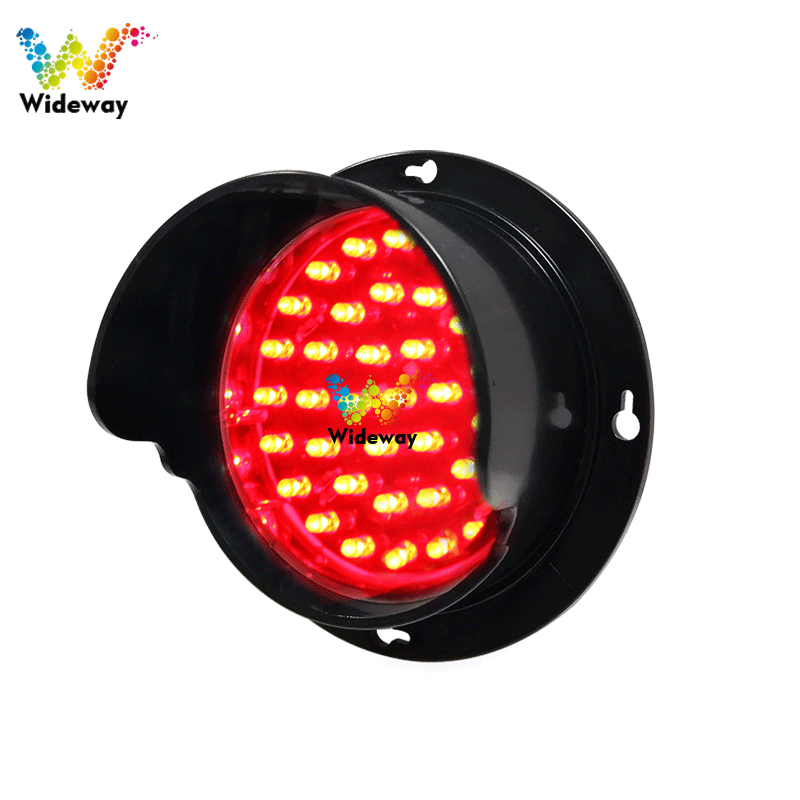
Not every signal light is meant for a busy city intersection. Many sites need something smaller and simpler: a factory gate, a weighbridge, a rolling shutter, a vehicle lane inside a storage yard. For places like these, a compact single-color unit is often all that is required. The Type 100 lamp housing from Shenzhen Wide Way Optoelectronics (WDM) is one such unit. This article explains what it is, what its listed specifications are, where it fits and what to keep in mind when installing it.
What the unit is
The Type 100 lamp housing is a 100mm LED signal lamp sold in three colors: red, yellow and green. On the manufacturer’s page it carries the model number WDM-C100-R/Y/G and the product name 100-Type Monochromatic Lamp Tube. Each housing is independently driven, so the three colors do not interfere with one another. If one unit fails, it can be replaced on its own without touching the other two signal paths.
That design is practical. A site that uses a red and a green unit does not have to scrap a whole assembly because one light stopped working.
Listed specifications
These figures are taken from the manufacturer’s product table:
- Dimensions: 135 x 135 x 70 mm
- Light source: 40 LED chips, described as Taiwan crystal chip light chips
- Wavelengths: red 620 to 625 nm, yellow 590 to 595 nm, green 500 to 505 nm (blue-green) or 520 to 525 nm (turquoise green)
- Shell material: PC plastic
- Operating temperature: -40°C to 60°C
- Protection grade: IP53
- Operating voltage: DC 12V or DC 24V
- Visible distance: at least 400 m
- Listed service life: 100,000 hours
As with any manufacturer figures, treat them as the starting point for your own checks, especially if your project must meet a local standard.
What each color communicates
According to the product page, the red unit indicates no entry or stop operations. Its listed uses include railway crossing closures, weighbridge occupancy, the downward operation of rolling shutters and vehicle access prohibitions. The yellow unit signals a warning or a waiting transition, such as a reminder to reduce speed or a sign that equipment is about to start or stop. The green unit shows that passage is allowed and the equipment is ready, so vehicles or people may enter.
The page also describes the yellow light as suitable for safety-conscious environments and equipment standby modes, since it is meant to be noticeable without being glaring.
Control options
The housing supports external signal controllers, PLCs, relays and other signal sources, which allows automatic switching on and off. Manual control is also possible. In practice this means the unit can follow a gate controller, a weighbridge system or a simple switch, depending on how your site is set up.
Problems it is designed to address
The manufacturer lists several pain points. Older halogen or outdated signal lights tend to have a short service life and need frequent maintenance, whereas LED sources last longer and reduce the number of inspections and lamp changes. Brightness and visibility in rain, fog or backlight can be a problem for weaker lights, so the unit uses a high-density LED array with a lens structure to concentrate light. Energy use is another concern, and LEDs draw less power than halogen lamps. Finally, the sealed housing with IP53 protection is intended for outdoor, humid and dusty conditions.
IP53 means protection against dust and against sprayed water. It does not mean the unit can be submerged, so choose the mounting position sensibly.
Wiring and installation
Wiring is straightforward. The red wire is the common positive terminal, the black wire is the negative, and the unit supports DC 12V and 24V. The housing has four mounting holes and is fixed to the installation surface with screws. The manufacturer’s example shows a vertical installation.
The page gives clear precautions. The casing is PC plastic, so avoid excessive pressure that could damage it. Power on only under the supervision of a qualified professional, and do not take the luminaire apart without authorization. Electrical work should be done by someone who knows what they are doing.
Warranty and after-sales terms
The manufacturer offers a 3-year original warranty covering the main structure and the core light source. Wear-and-tear parts such as lampshades and connecting cables, and customized non-standard products, are not covered. Damage from misuse, unauthorized modification or events such as fire, earthquake or abnormal voltage is also excluded. For repairs, the customer contacts after-sales service first to register the fault, then returns the product once authorized. The customer pays one-way shipping to the service point, and for defects that fall under warranty the brand owner pays the return shipping.
The package includes one lamp housing, a certificate and a product specification covering technical data, installation steps and safety and maintenance guidance.
Buying tips
Before ordering, confirm the color you need, the supply voltage, the mounting arrangement and whether your controller or PLC can drive the unit. Ask for the specification sheet and certificate, and read the warranty terms carefully. If your project needs a particular standard or certification, ask the supplier to confirm it in writing instead of assuming.
Final thoughts
The Type 100 lamp housing is a small, focused product for sites that need clear red, yellow and green indication without the size of a full traffic signal. Its independent units, DC 12V or 24V supply, IP53 protection and simple screw mounting make it easy to plan around. Check the details against your own site, have a qualified electrician install it, and it can serve as a dependable part of a safe and orderly site.