

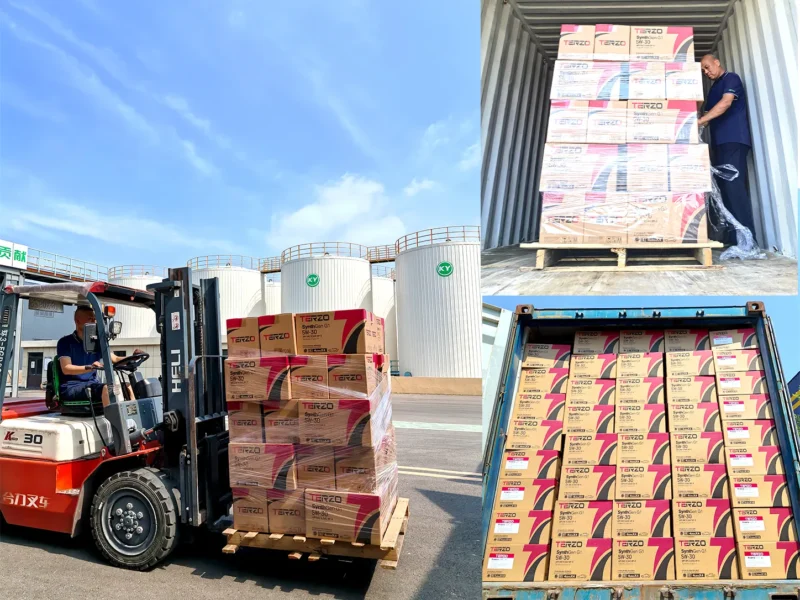
Buying engine oil for your own car is simple. You read the label, match the viscosity grade and pay at the counter. Buying it by the pallet or container for resale is a different job altogether. The wrong partner can leave you with delayed shipments, inconsistent batches or customers who never come back. The right one becomes the quiet backbone of your business.
If you are an importer, a workshop owner or a new distributor, here are the questions worth asking before you commit to an engine oil supplier, with TERZO’s published information used as a practical example.
Look at the actual product range
Start by checking whether the supplier covers the products your customers really buy. Most distributors do not sell only passenger car oil. Workshops also ask for diesel oil, motorcycle oil, transmission fluid, coolant and brake fluid, and more of them now ask about fluids for electric vehicles.
When you review an engine oil supplier, compare its catalog with your market. TERZO lists passenger car engine oil, diesel engine oil, motorcycle oil, transmission fluid, antifreeze and coolant, brake fluid, electric vehicle fluids and industrial oils. Its motorcycle range is described as covering JASO MA, MA2 and MB grades, and its brake fluids as available in DOT 3, DOT 4, DOT 4 Plus and DOT 5.1. A wider range means fewer separate suppliers to manage.
Ask about quality systems, not only promises
Anyone can write that their oil is high quality. What counts is the system behind it. Look for recognized management certifications and ask to see the documents. TERZO states that it holds ISO 9001, ISO 14001, IATF 16949 and OHSAS 18001 certifications, along with third-party verification from SGS.
Certificates are not a guarantee of every batch, but they do show that processes are written down, checked and audited. Ask also about batch records, how samples are kept, and what happens if a customer reports a problem.
Understand the raw materials
The base oil and additive package make up most of what a lubricant is. TERZO’s website shows logos of raw material partners, including Lubrizol, Infineum, Afton, Chevron, ADNOC, Mobil and Shell. It also states a base oil storage capacity of 20,000 tons. When you speak with any supplier, ask which base oil groups are used for each grade, and request technical data sheets so you can compare specifications yourself.
Check capacity and stock
A supplier who cannot deliver on time is a risk, however good the product. TERZO reports an annual output of 75 million bottles and a 3,000 square meter ready-stock warehouse that supports faster fulfillment for selected products. For custom orders, the company says production schedules, packaging and delivery timelines are confirmed in advance. Its stated lead time for routine orders is 15 to 30 days, and OEM or custom packaging orders may take longer.
These are the company’s own figures, so a serious buyer should confirm them through a call, a video tour or a visit.
Be clear on minimum orders and terms
Small and mid-sized buyers often worry about minimum quantities. TERZO says a trial order for its own branded goods can be as low as 100 cartons, depending on availability, while OEM and private-label minimums vary by product. It supports T/T payment and can discuss trade terms such as EXW, FOB, CFR and CIF, with final terms agreed between both sides. Whatever supplier you choose, get quantities, prices, payment terms and delivery responsibilities written down before money moves.
Consider packaging and branding
Packaging affects both shipping cost and how your product looks on a shelf. TERZO lists standard packaging sizes including 1L, 4L, 20L and 200L, and offers private-label options so a distributor can build its own brand. If you plan to do this, ask about label approval, artwork requirements and how long the process takes.
Check support and presence
A supplier’s website tells you only so much. Look for real contact details, offices and references from existing partners. TERZO lists offices in Italy, Hong Kong, Singapore and China, and describes partner projects in the Philippines, Tanzania, Kazakhstan and Oman. Reach out and ask direct questions. How quickly and clearly they answer is often a good preview of how they will behave after you place an order.
A short buyer’s checklist
- Confirm the product range matches your market.
- Request certificates and technical data sheets.
- Ask about raw materials and batch control.
- Verify stock, capacity and lead times.
- Clarify minimum orders, payment and shipping terms.
- Test communication before you commit.
Starting with a small trial order is a sensible way to judge quality and service before you scale. A good partnership is built on honest information and steady delivery, and both are easier to verify early than to fix later.