

Creating a new product often requires more than a good idea. Designers need to develop a visual concept, produce a prototype, evaluate its appearance, and prepare the design for manufacturing or presentation. For small businesses and independent creators, these steps can consume valuable time and money, especially when they do not have access to a dedicated design team.
AI 3D modeling is creating new possibilities for people who want to develop products without building every model from scratch. By generating three-dimensional assets from images or text descriptions, these tools can help users explore ideas, prepare early concepts, and experiment with different designs. They can also support creators who make customized gifts, decorative objects, collectible figures, and other products for specific audiences.
AI does not eliminate every production expense, and a generated model may still require editing before it can be manufactured. However, when used for the right tasks, AI 3D tools can make early-stage development more accessible and flexible.
Test Product Ideas Before Investing in Manufacturing
For a small business, developing an unfamiliar product can involve considerable uncertainty. A business owner may have an idea for a desk accessory, a decorative item, or a household product but lack a clear picture of how the finished object should look. Commissioning a detailed model for every possible concept may be too expensive, particularly when the idea has not yet been tested with customers.
AI 3D modeling offers a way to explore initial concepts before committing to a more expensive design process.
A creator can begin with a simple description of the proposed product, generate a preliminary model, and compare different shapes or visual styles. For instance, a small business planning to sell personalized desk organizers could explore several layouts, including compact versions for small workspaces and larger designs with separate compartments.
These early models can help the team discuss proportions, appearance, and general usability. They may also provide useful visual material for internal reviews or initial customer feedback.
The important distinction is between a concept model and a manufacturing-ready design. AI-generated geometry can help communicate an idea, but products with precise dimensions, moving components, electrical parts, or safety requirements may need professional engineering and additional testing.
For businesses with limited resources, the greatest benefit is often the ability to compare ideas earlier. Instead of investing heavily in a single direction, they can identify promising concepts before moving into detailed development.
Create More Personalized Products
Personalization can help small businesses differentiate themselves from mass-market competitors. Customers may want a gift featuring a name, a decoration inspired by a favorite hobby, or an accessory designed around a particular interest. However, producing a completely different design for every customer can be difficult when the process depends on extensive manual modeling.
AI 3D tools can help creators explore a wider range of design variations.
Consider a small online store selling themed decorative objects. Rather than offering only a few fixed designs, the business might experiment with different visual themes, shapes, or decorative elements. A creator could develop a basic concept and then generate variations suited to different customer preferences.
Personalized products may include:
- Decorative nameplates and desk ornaments.
- Hobby-themed accessories and display pieces.
- Customized miniature figures and collectibles.
- Decorative reliefs inspired by photographs or illustrations.
- Original gifts for birthdays, holidays, and special occasions.
Image-to-3D generation can be particularly useful when a design begins with an existing picture or visual reference. It provides a way to turn a photo to 3d model and investigate how a two-dimensional idea might translate into a three-dimensional object.
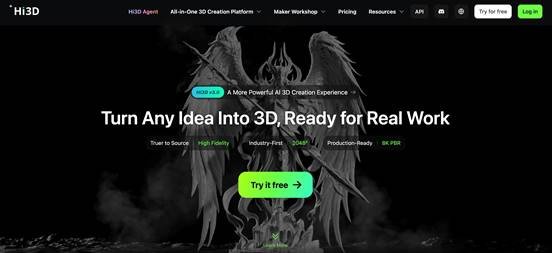
Platforms such as Hi3D support image-to-3D generation and other AI-assisted creation tools. These capabilities can provide a starting point for exploring customized designs, although the suitability of each result depends on the reference image, the object’s complexity, and the intended production method.
Businesses should also establish a clear boundary between customization and fully bespoke design. Allowing customers to choose from several tested options is usually easier to manage than promising unlimited design changes for every order.
Develop Visual Prototypes for Online Stores
Selling a physical product online requires customers to understand what they are buying before they can handle it. Product photographs are important, but they may not communicate every aspect of an unfamiliar design, especially when the product has an unusual shape or multiple components.
Three-dimensional models can provide another way to present a product concept.
A small business could use a 3D asset to prepare product previews, create promotional graphics, or explore how an object might appear from different viewpoints. A digital model can also help a team evaluate whether a proposed design is visually consistent with the rest of its product range.
For example, an independent home décor brand may be considering a collection of sculptural vases. Before commissioning physical samples of every variation, the designer could generate initial models to compare silhouettes, decorative patterns, and proportions. The selected concepts could then be refined for more accurate visualization or prototyping.
There is an important limitation: a generated model is not automatically a substitute for a photograph of a real product. It may not accurately represent the final material, finish, color, or manufacturing details. If an image is used in a product listing, businesses should make sure it does not mislead customers about what will actually be delivered.
For early-stage marketing and internal evaluation, however, digital models can help communicate a concept before physical samples are available. They can also support discussions with manufacturers, collaborators, and potential business partners.
Explore Small-Batch Products Without Building a Large Inventory
Traditional product development can encourage businesses to produce a substantial quantity of an item to spread setup costs across many units. That approach can be risky when demand is uncertain or the product serves a narrow audience.
Digital design and 3D printing offer another approach for some product categories. Instead of manufacturing large quantities immediately, a business may be able to produce a limited number of items, evaluate customer interest, and adjust the design before expanding production.
AI 3D modeling can support the design stage of this process by helping creators prepare initial models for low-volume products. Examples include small decorative objects, collectible accessories, tabletop gaming pieces, and customized display items.
A creator could test several designs with a small audience, select the most popular options, and then prepare the chosen models for production. This can be useful for independent artists and niche brands whose customers value originality more than standardized mass production.
Nevertheless, low-volume production is not automatically inexpensive. Material costs, printing time, failed prints, finishing, packaging, and shipping can all affect profitability. A complex object may take longer to print and assemble than a simpler alternative, even if the initial model was generated quickly.
Before launching a product, businesses should calculate the complete cost per unit and consider how much time is required for post-processing. AI can reduce some design effort, but it does not remove the practical costs of making and delivering a physical object.
Build a Distinctive Visual Style for a Small Brand
Small brands often compete through their visual identity. A recognizable design language can help customers distinguish a business from competitors, especially in crowded markets such as handmade gifts, home décor, collectibles, and hobby products.
AI 3D modeling can help creators experiment with that visual identity. A designer might explore rounded organic shapes, geometric patterns, futuristic forms, or a consistent set of decorative motifs before deciding which direction best represents the brand.
Once a visual direction has been selected, the creator can apply it across a collection of related objects. For example, a brand selling desk accessories might use consistent shapes and surface details across pen holders, cable organizers, and small storage containers.
Texturing tools can contribute to this process by allowing creators to explore different surface appearances. A single basic form might be presented with a wood-inspired look, a metallic finish, or a colorful stylized texture, depending on the purpose of the design.
Hi3D includes AI-assisted texturing capabilities that can help users explore the appearance of generated models. For a small business, this may be useful during visual experimentation, especially when comparing different creative directions.
Still, a coherent brand style requires human judgment. Generating many unrelated models does not necessarily create a recognizable collection. Businesses should define a few consistent visual principles, such as shape language, color palette, surface treatment, or intended audience, and use them to guide the selection process.
Prepare Products for Different Customer Needs
A product concept may need several versions to suit different customers. A decorative item might be offered in multiple sizes, while an accessory may require a compact version for personal use and a larger version for display. Exploring these variations can be useful, but each version must still work for its intended purpose.
AI 3D modeling can help creators investigate alternative designs before investing in detailed modeling. The process might begin with one basic concept and then explore changes to its overall proportions, decorative features, or arrangement of components.
For businesses developing products for 3D printing, size and structure deserve particular attention. A visually appealing model may become fragile when scaled down, while a larger version may exceed the build volume of a particular printer.
Some designs may also benefit from being divided into separate parts. A large decorative sculpture, for example, might be easier to print and transport as several sections rather than one oversized object.
Hi3D’s Split-to-Print functionality is designed to divide larger models into smaller sections and add connectors for assembly. This can be relevant to creators exploring products that exceed a printer’s available build area. However, each divided model still needs to be checked for connector strength, alignment, assembly fit, and printability.
Businesses should avoid assuming that one digital design can be resized or modified indefinitely without further validation. Every meaningful variation may require checks for dimensions, stability, material use, and manufacturing constraints.
Make Product Development More Collaborative
Small businesses frequently rely on collaboration between people with different responsibilities. A founder may understand the customer problem, a designer may focus on appearance, and a manufacturing partner may be responsible for production. These people need a shared way to discuss the proposed product.
Three-dimensional models can make those conversations more concrete.
A written description may leave room for different interpretations, while a model allows collaborators to inspect the same general shape. Team members can discuss proportions, placement of components, or visual details before deciding whether the design should move forward.
AI tools can help produce an initial model quickly enough to support these discussions. The model does not have to be perfect to be useful; it simply needs to communicate the idea clearly enough for the next decision.
For instance, a small gift business could prepare several early concepts for a client and use them to discuss preferred shapes or decorative elements. After the client chooses a direction, the business can refine the selected design and confirm the practical requirements.
This approach can also help businesses identify disagreements earlier. If a proposed product looks different from what a collaborator expected, the team can clarify the requirements before paying for detailed modeling or manufacturing.
For complex products, the generated model should be treated as a communication aid rather than a final technical specification. Dimensions, material requirements, tolerances, and production drawings may still need to be prepared separately.
Use AI 3D Tools Without Overspending
Adding new software to a small business can introduce its own costs. Some platforms charge for generation credits, advanced features, downloads, or commercial usage. Other expenses may arise when a model needs external editing or conversion.
The best approach is to choose tools according to the work that actually needs to be done.
Before committing to a platform, identify the main goal. Is the business trying to test product concepts, create promotional visuals, develop printable objects, or produce assets for digital content? Different tasks require different capabilities, and a tool designed for one purpose may not be suitable for another.
A practical evaluation should include several questions:
- Can the tool handle the type of input the business already has?
- Is the generated model detailed enough for the intended use?
- Can the model be exported in a compatible format?
- Will additional editing or technical expertise be required?
- Are the usage terms suitable for the intended commercial activity?
- How predictable are the costs when creating multiple variations?
It is useful to test a small project before adopting a platform for ongoing work. Track the time spent generating, correcting, exporting, and preparing the model. This provides a more realistic picture of the total effort than generation speed alone.
Hi3D offers multiple AI-assisted 3D creation capabilities, including model generation, texturing, and export options. It may be worth evaluating for projects that combine visual experimentation with preparation for downstream workflows. As with any platform, businesses should review the current plans, feature availability, and usage terms before relying on it for commercial production.
Know When Professional Design Support Is Still Necessary
AI tools can make product exploration easier, but some projects require specialized knowledge that goes beyond generating a plausible shape.
A decorative display object may need relatively little technical intervention. A product that supports weight, contains moving mechanisms, interacts with electrical components, or must meet specific safety standards requires a more careful process.
The distinction is especially important when a product will be sold to customers. A model that looks convincing is not proof that the object is safe, durable, or suitable for its intended use. Businesses remain responsible for checking applicable requirements and validating the finished product.
Professional designers and engineers can help refine dimensions, identify structural weaknesses, and prepare designs for manufacturing. For 3D-printed products, experienced users may also need to inspect wall thickness, tolerances, supports, and material behavior.
A practical strategy is to use AI for early exploration and involve specialists when a project reaches a stage that demands technical precision. This can help a small business avoid spending professional design time on concepts that are unlikely to be pursued while still giving important products the attention they require.
Turning Creative Experiments into Business Opportunities
For small businesses and independent creators, AI 3D modeling is most valuable when it helps answer practical questions. Which product concept is worth developing? Which visual style best suits the target audience? Can a design be adapted for a different customer group? Is a proposed object worth the cost of producing a physical prototype?
These questions connect digital creation to real business decisions. AI-generated models can support brainstorming, early visualization, customer discussions, and the exploration of small-batch products. They can also help creators who lack extensive 3D modeling experience participate in the initial stages of product development.
Success still depends on choosing appropriate projects and evaluating the results carefully. Businesses need to account for software costs, post-processing, manufacturing, and customer expectations rather than assuming that fast generation automatically leads to higher profits.
By combining AI-assisted modeling with clear product goals and realistic production planning, small businesses can explore more ideas, make better-informed decisions, and develop distinctive products without committing significant resources too early.