

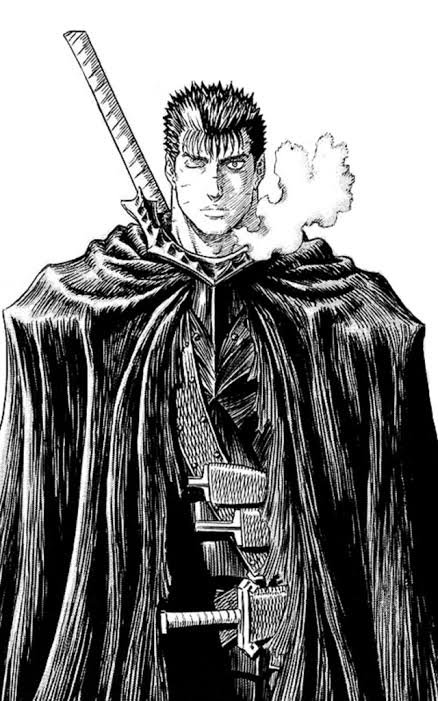
Berserk owes much of its power to characters who rarely fit into simple categories of hero and villain. Kentaro Miura built a dark fantasy world where ambition, trauma, friendship and obsession constantly collide, and the people caught in that conflict evolve dramatically over the course of the manga. Guts may stand at the center of the story, but understanding him requires looking at Griffith, Casca and the many figures who influence his choices.
The series begins with an apparently straightforward image of Guts as the Black Swordsman, a brutal warrior carrying an enormous sword and hunting demonic Apostles. His past gradually reveals a much more complicated man. His anger is not simply a personality trait. It grows from abandonment, violence, betrayal and his desperate attempts to decide what kind of life belongs to him rather than to someone else’s dream.
That emotional complexity explains why Berserk characters have remained so memorable. Their visual designs are instantly recognizable, which also explains their strong presence in anime merch, but their appeal goes far beyond appearance. Miura treats each major character like a piece of the same broken mirror. Guts represents struggle, Griffith ambition, Casca survival, while figures such as Skull Knight and Schierke reveal different ways of facing a world shaped by supernatural forces.
The result is a cast whose relationships matter as much as battles. Rivalries become friendships, admiration becomes resentment, love becomes a source of both healing and pain. The most important characters therefore cannot be understood only by asking how strong they are. Their place in the story of Berserk depends on what they want, what they lose and how they respond when fate seems determined to crush them.
Guts, the warrior at the center of Berserk
Guts is the protagonist and the character through whom readers experience most of the manga’s world. Born from the corpse of his mother and raised among mercenaries, he grows up surrounded by violence. Fighting becomes both his profession and his survival mechanism. Yet reducing him to a powerful swordsman misses the point. Guts’ character development is built around his struggle to become something more than a weapon.
His enormous sword, the Dragonslayer, reinforces his intimidating reputation, but his defining characteristic is endurance. Guts keeps moving even when his body is exhausted, his relationships are shattered and supernatural enemies pursue him. His determination reaches another level when he obtains the Berserker Armor, which allows him to ignore physical limits at a devastating cost. Collectors often associate Berserk figures with this armored version of Guts because it captures the character’s most ferocious visual identity.
Guts is not fearless. Much of his strength comes from acting despite fear, grief and rage. His hatred of Griffith initially pushes him toward revenge, but the manga gradually challenges that obsession. Protecting Casca and travelling with new companions forces him to rediscover trust. This shift is crucial because the Black Swordsman cannot remain emotionally isolated forever without destroying himself.
His internal conflict is represented by the Beast of Darkness, a manifestation associated with his rage, bloodlust and desire to surrender to revenge. It is tempting to view the Beast as a separate evil force, but it is more meaningful as an expression of impulses already present within Guts. His greatest battles therefore occur both outside and inside himself.
Why is Griffith so important?
Griffith is Guts’ opposite in almost every obvious way. Where Guts appears rough, direct and physically imposing, Griffith is elegant, charismatic and calculating. He creates the Band of the Hawk and leads it from obscurity toward military fame, driven by one overwhelming ambition, obtaining a kingdom of his own.
His dream inspires others because Griffith seems capable of making the impossible achievable. Soldiers are willing to risk their lives for him, and even Guts becomes fascinated by his confidence. Yet Griffith’s charisma hides a deeply possessive side. He values Guts enormously, but he struggles to accept Guts as someone capable of choosing a path independent of him.
That conflict becomes one of Berserk’s central turning points. When Guts leaves the Band of the Hawk to search for his own purpose, Griffith loses emotional control. The consequences ultimately lead to imprisonment, torture and the collapse of everything he built. Faced with absolute despair, Griffith activates the Crimson Behelit and sacrifices the Band of the Hawk during the Eclipse.
His transformation into Femto, one of the God Hand, permanently changes the story. Griffith is no longer simply Guts’ former commander or rival. He becomes a supernatural being tied directly to the forces governing causality in Berserk’s universe. His later return to the physical world and creation of Falconia make him even more ambiguous to ordinary people, who see him as a savior rather than the architect of one of the manga’s greatest tragedies.
Casca is far more than a supporting character
Casca begins as one of Griffith’s most capable commanders and one of the strongest soldiers in the original Band of the Hawk. She is disciplined, proud and fiercely loyal. Her initial hostility toward Guts partly comes from the disruption he creates inside a group that had given her life direction and meaning.
Her feelings become more complicated as she fights alongside him. Guts and Casca develop mutual respect before their relationship becomes romantic. This relationship humanizes both characters. For Guts, Casca represents a connection based on vulnerability rather than combat. For Casca, Guts forces her to question a life built entirely around Griffith’s dream.
The Eclipse destroys that balance. Casca survives, but severe psychological trauma leaves her in a regressed state for a large portion of the story. Guts subsequently becomes her protector, although his anger and emotional instability sometimes make that responsibility painfully difficult. Her condition becomes one of the main reasons his revenge-focused journey changes direction.
Casca’s eventual restoration of her mind is one of the manga’s most significant developments. Recovery does not erase trauma. Her reactions to Guts show that memories and emotional wounds remain complicated, which gives Casca’s role in Berserk a depth that cannot be reduced to being Guts’ love interest.
The Band of the Hawk shaped Guts’ identity
The original Band of the Hawk gives Guts something he had almost never experienced before, belonging. Characters such as Judeau, Corkus, Pippin and Rickert may receive less attention than the central trio, but they are essential to the Golden Age arc. They turn a mercenary company into a community.
- Judeau, perceptive and loyal
- Pippin, powerful and dependable
- Corkus, cynical and outspoken
- Rickert, young and resourceful
Judeau stands out because of his emotional intelligence. He understands people well, notices the developing bond between Guts and Casca and often acts with quiet selflessness. Pippin provides physical strength and reliability, while Corkus openly resents Guts and gives the group a more believable internal tension. Rickert becomes especially important because he survives the Eclipse without witnessing it directly.
The deaths of most of these characters make the Eclipse devastating precisely because readers have already spent considerable time with them. They are not anonymous casualties. Their loss destroys Guts’ first genuine sense of family and transforms his relationship with Griffith into something driven by grief as much as anger.
Guts finds a new group of companions
One of the most important changes in later Berserk is that Guts gradually stops travelling alone. His new companions differ radically from the Band of the Hawk, but they become another form of family. Puck, Farnese, Serpico, Schierke and Isidro each affect a different part of his personality.
Puck and Isidro bring humanity back into the journey
Puck is an elf who accompanies Guts during some of his darkest periods. His playful personality creates contrast with the brutality surrounding them, but he also serves a deeper purpose. Puck repeatedly reminds readers that compassion still exists inside Guts, even when the swordsman tries to suppress it.
Isidro is younger and dreams of becoming a great swordsman. He admires Guts’ strength, although his impulsiveness often creates problems. Through Isidro, readers see Guts placed in a role he never expected to occupy, that of a more experienced warrior whose actions influence the next generation.
Farnese, Serpico and Schierke change the group’s balance
Farnese undergoes one of the strongest transformations among the supporting cast. Initially introduced as a commander of the Holy Iron Chain Knights, she is insecure beneath her religious authority. Her encounters with Guts expose how fragile her worldview really is. She eventually chooses to travel with him and begins studying magic under Schierke.
Serpico is calmer and far more dangerous than his relaxed manner suggests. His loyalty to Farnese defines many of his decisions, including his willingness to oppose Guts when he considers him a threat to her safety. Schierke, meanwhile, expands the supernatural dimension of the story. As a young witch trained in astral magic, she helps Guts understand forces that cannot simply be defeated by swinging the Dragonslayer.
Schierke also becomes vital whenever Guts uses the Berserker Armor. Her magical abilities help him maintain some control rather than disappear completely into rage. Their partnership illustrates how far Guts has travelled emotionally. The man who once rejected almost everyone now survives partly because he allows others to help him.
Skull Knight remains one of Berserk’s greatest mysteries
Skull Knight appears as a mysterious armored warrior who understands Behelits, Apostles and the God Hand far better than Guts does. He repeatedly intervenes at crucial moments, most famously during the Eclipse, when he helps Guts and Casca escape.
His history has never been presented in a completely straightforward way, but the manga strongly connects him with the ancient figure known as King Gaiseric. Memories associated with the Berserker Armor also suggest that Skull Knight may once have used it himself. This creates a possible parallel between him and Guts, two warriors consumed by long conflicts against supernatural enemies.
Skull Knight’s opposition to the God Hand has apparently lasted for an extraordinary amount of time. His knowledge of causality suggests experience far beyond that of ordinary humans. Yet his struggle also serves as a warning. If revenge completely defines Guts, Skull Knight may represent one possible version of what remains.
The God Hand stands above ordinary antagonists
The God Hand consists of five major supernatural entities, Void, Slan, Ubik, Conrad and Femto. They occupy a position far beyond ordinary Apostles and appear connected to the deeper laws governing Berserk’s world. Their influence is especially visible during sacrificial ceremonies involving Behelits.
Each member has a distinct presence. Void often appears closest to a formal leader, speaking about causality and sacrifice with chilling calm. Slan is associated with cruelty, desire and fascination with human suffering. Ubik manipulates perception and emotion, while Conrad remains more mysterious. Femto is unique because readers know exactly who he once was.
- Void, causality and ritual
- Slan, desire and cruelty
- Ubik, manipulation and illusion
- Conrad, plague and corruption
- Femto, ambition transformed
The God Hand members matter because they expand Berserk beyond a personal revenge story. Guts’ hatred of Griffith may be intensely personal, but Griffith belongs to a system of supernatural forces that appears to manipulate human history itself. Defeating one enemy may therefore be very different from escaping the structure surrounding him.
Why Berserk’s characters remain so memorable?
The strongest characters in Berserk are not memorable simply because of their abilities. Guts can defeat monsters that would destroy ordinary soldiers, Griffith commands armies and supernatural beings, and Skull Knight confronts creatures beyond human understanding. Yet power alone is rarely what makes their scenes compelling.
Miura constantly connects action to emotion. Guts’ sword matters because of what he is trying to protect. Griffith’s ambition matters because of what he is willing to sacrifice. Casca’s survival matters because she must live with consequences that cannot be undone. Even supporting characters such as Farnese become significant because their beliefs visibly change through experience.
The relationships are equally important. Guts and Griffith move from fascination and friendship to one of manga’s most destructive rivalries. Guts and Casca develop a bond shaped by love, trauma and responsibility. Farnese discovers purpose outside the rigid institutions that once defined her, while Schierke learns to interact with a world much larger and harsher than the one she knew.
This is why Berserk’s cast continues to resonate decades after the manga began. Its characters are rarely static symbols of good and evil. They desire, fail, change and sometimes become trapped by the very dreams that once gave them purpose. Guts remains the clearest example. His struggle is not merely about surviving another Apostle. It is about deciding whether pain will dictate the person he becomes.