

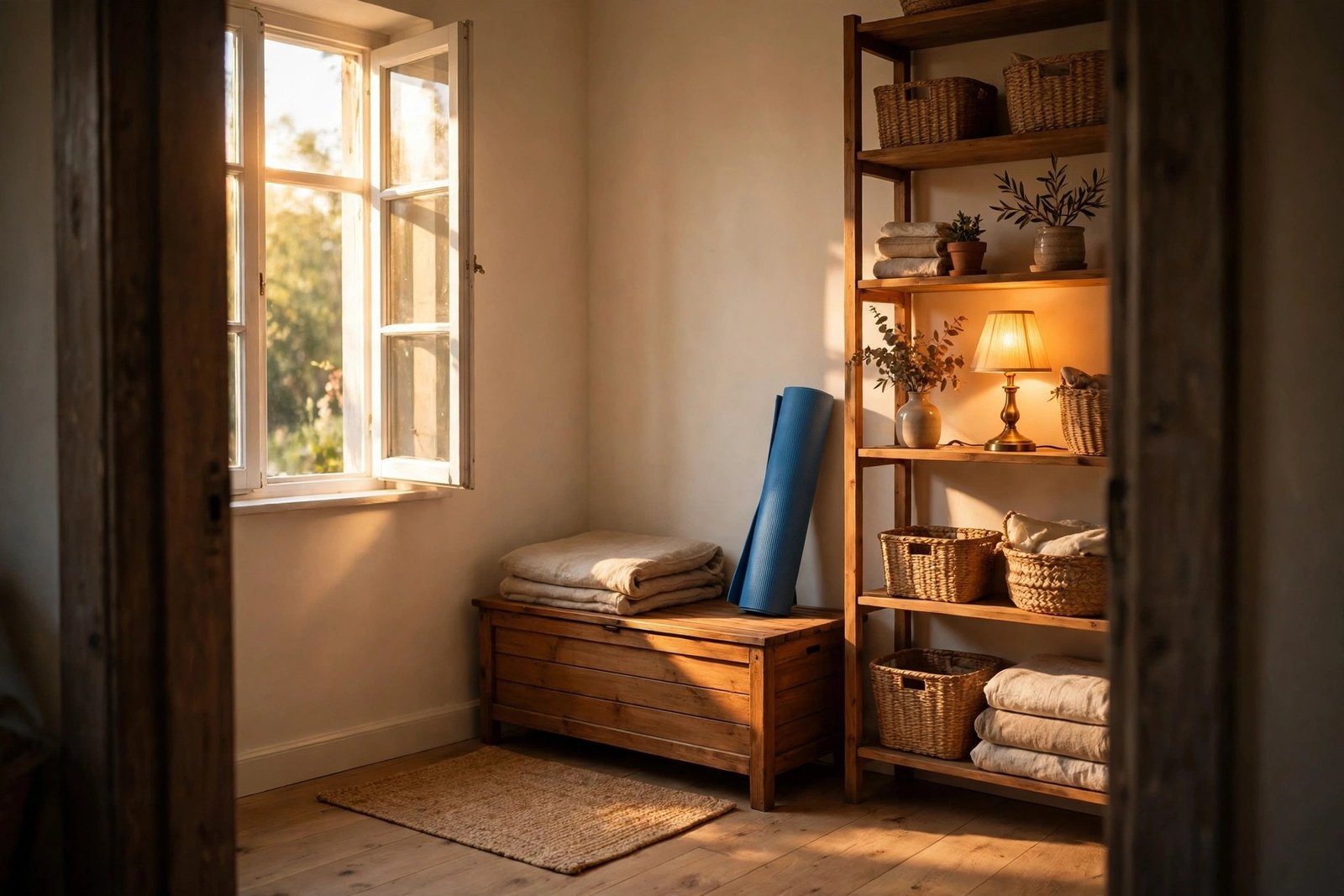
I’d start this video in the doorway of a narrow spare room. A folded exercise mat leans against a bench, a lamp picks out the edge of the rug, and the room looks too small for a workout. Then a hand pulls the bench forward, the lid lifts, and the first things we see are the handles of two resistance bands. Ten seconds later the room still looks like the same room, but the rug is rolled back and there’s enough space to stretch. I’d make that change the whole story of a short video for a home and lifestyle article.
What the opening frame needs to establish
The room has two useful anchors in the frame: the bright window on the left and the tall shelf beside the bench. I’d take a photograph from the doorway with both visible and leave some empty floor at the bottom of the image. That empty space is doing useful work. When the mat unrolls toward the camera, the viewer can see where it’s going and why moving the bench made a difference. I’d keep the entrance and knocking sound out of the opening. The photo should feel as if we’ve already stepped inside and paused to look around. A straight-on photo could start the image-to-video version, but I’d also want the lid motion to have a credible weight. That’s where the reference workflow in seedance 3.0 fits this little production: a still for the room, a short video of the real bench opening, and an audio clip with the quiet latch click. Each asset answers a different question. The still establishes the room’s layout, the video shows how the lid slows near the top, and the sound tells the editor when the little reveal should land. I’d use text to describe the hand’s action, framing, and intended endpoint.
The hinge is a better cue than a camera move
I’d record the bench reference from the side so there’s no doubt about which edge lifts. I’d trim the clip to begin a fraction of a second before the latch opens and end while the lid is still held up. The recording can look plain. Its value is the motion, especially the tiny pause as the hand switches from pulling the latch to guiding the lid. The generated shot would keep the wider doorway angle from the still, which gives the viewer context for why the bench moves at all. My opening prompt for Seedance 3.0 would describe a fixed doorway view in late-afternoon light. A hand reaches down from the right, slides a low oak storage bench just far enough to clear the rug, and lifts its lid once. A resistance band with two black handles rests inside. The window, shelf, and rug hold their positions. The shot settles with the lid held open and goes quiet after the latch click. I’d leave out the person’s face and describe a visible sleeve cuff to connect the hand across the next cut.
Making the second shot earn the cut
An overhead view of a mat unrolling would be easy to picture on its own, and I’d try it first as a separate text-to-video prompt. I’d describe the grain of the floor, a soft blue mat, and the moment when the curled edge finally lies flat. That test would help me decide how much of the action fits on screen. For the actual edit I’d come down from overhead and keep one bench leg in frame. It would sit close enough to the blue mat that the viewer can locate both shots in the same room. If Seedance 3.0 gave me a floor that suddenly looked wider, I’d revise the prompt around measurable positions the still already shows. The folded mat starts by the front leg of the bench, and the far edge stops short of the shelf. I’d also cut from the hand lowering the lid to the hand releasing the roll of the mat. That match in motion would connect the shots with very little screen time. The bench lid already carries the reveal, so the second shot can simply show that the cleared floor is useful.
A quiet soundtrack belongs to this room
I’d record the room tone on the same afternoon as the reference clip, with the window and door in the positions shown in the still. A soft sound from outside is fine. I’d trim long pauses or stray speech so the clip gives the generation a clean sense of the latch, the room, and the pause afterward. If the generated sound from Seedance 3.0 adds a sharp scrape on the tile, I’d compare it against a version with my own latch recording laid over the cut. A lined floor and felt pads make a modest sound, and that detail can sell the bench’s weight.
The shot I’d revise first
The tell I’d look for first is a changing bench hinge. A small shift in where the lid is attached can make the movement hard to follow, especially on a phone where the hinge occupies very few pixels. I’d split sliding the bench and lifting the lid into separate shots if the two actions muddle one another. The wide shot ends with the bench in place. A closer image-to-video version starts from a photo taken after the slide and only has to show the lid opening. I’d check that the gap between bench and shelf is consistent on both sides of the cut. I’d judge the Seedance 3.0 variations by whether the viewer can retell what changed in one sentence: the bench held the gear and made room for the mat. If a take looks elegant but the viewer thinks a second room has appeared, I’d keep the plainer version with the clear shelf and window. For the short video, showing a recognizable layout twice does more than an elaborate transition. It helps the home article demonstrate a change a reader could make in their own room.
The frame I’d end on
For the last shot I’d return to the doorway. The same lamp is on, the bench is shut, and the blue mat runs toward the lower edge of the frame. I’d leave that shot up long enough for the viewer to compare it with the opening, then export a vertical cut that keeps the shelf and mat in view. My final Seedance 3.0 pass would focus on that stillness and give me a few frames to hold cleanly. The last image has a job of its own: someone who scrolls in halfway through should still understand where the workout gear goes and how much floor it takes to use it.