

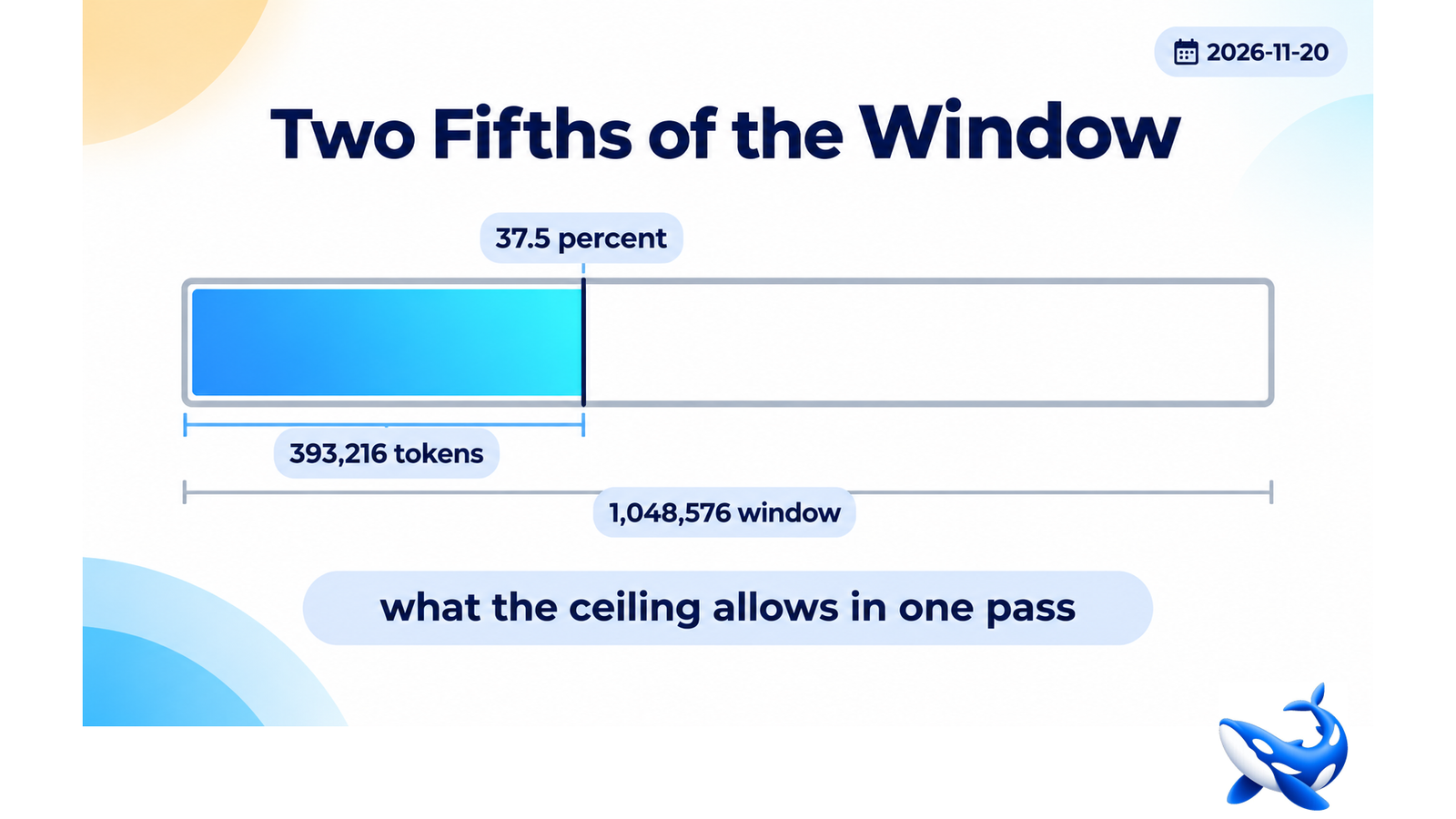
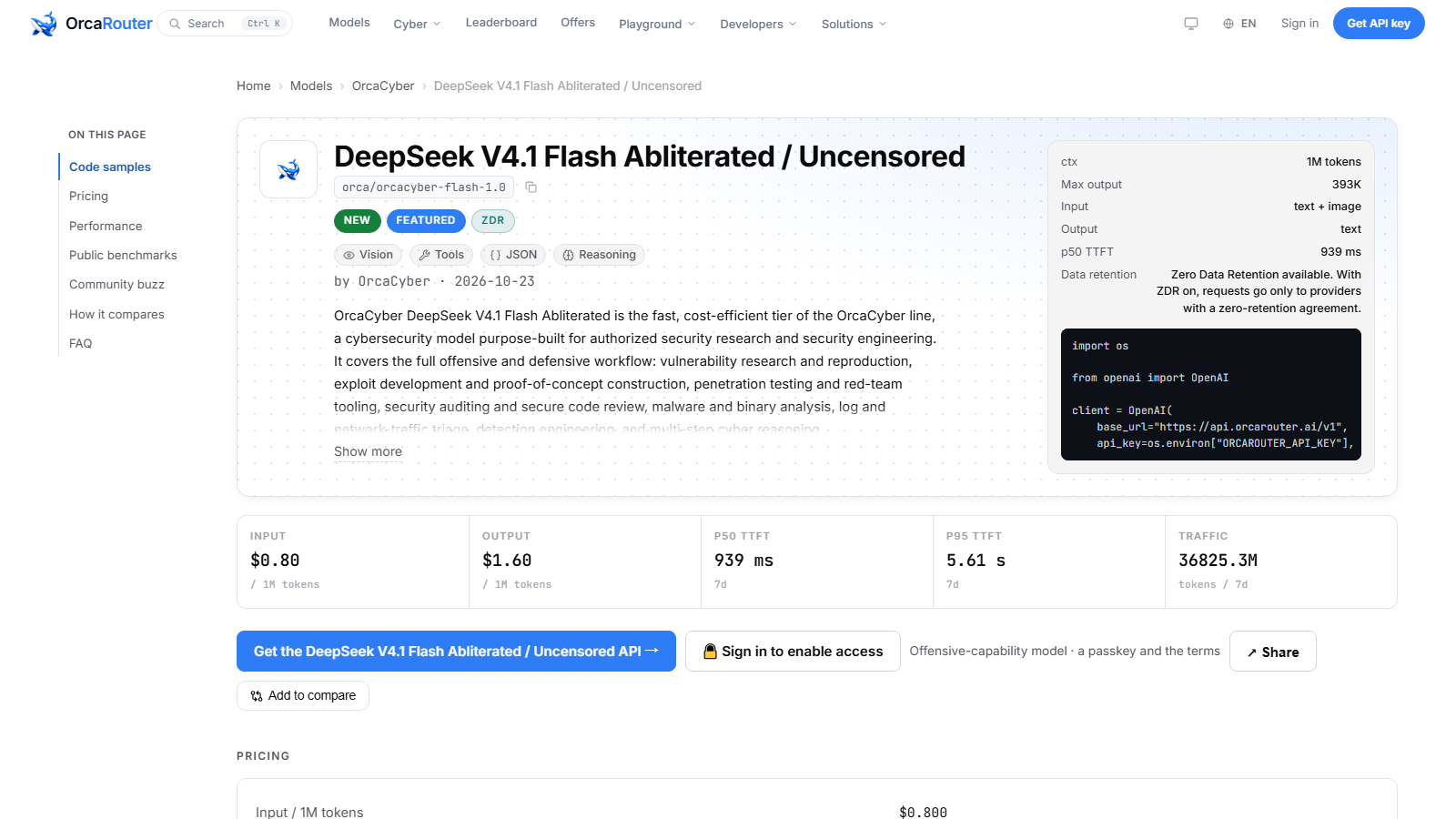
Three hundred ninety-three thousand is the largest answer this card can produce in one pass, and that is 37.5% of the window it can read from. OrcaRouter publishes both fields on the card. The pair is on OrcaCyber Flash 1.0 context: a 1,048,576-token context against a 393,216-token output ceiling.
The ratio, ranked
Most cards in this tier stop output far below their window. The ratio of the two fields is the quantity that decides whether a long-input, long-output job fits in one call.
| card | context | max output | ratio |
|---|---|---|---|
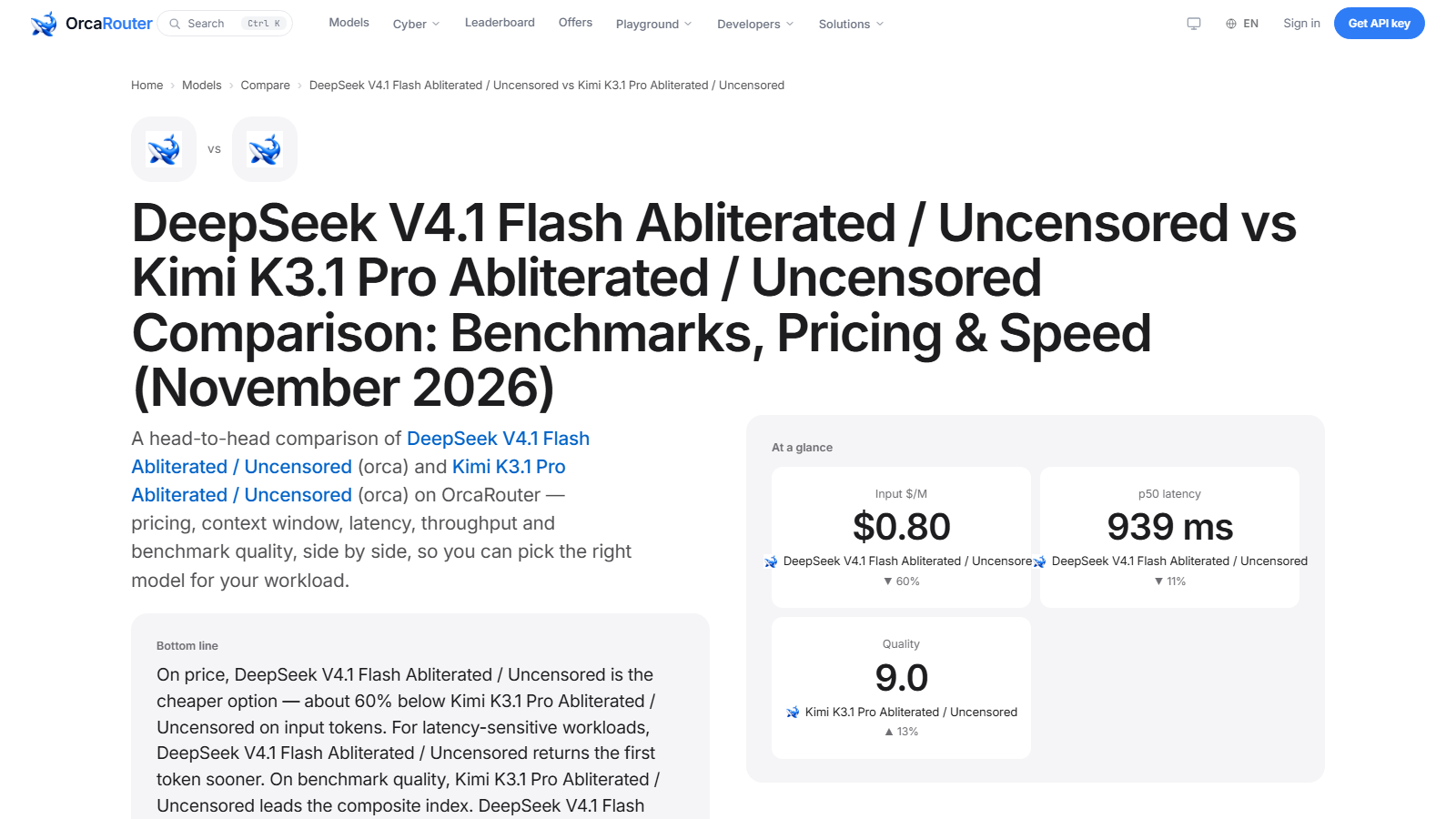
| K3.1 Pro | 1,048,576 | 943,718 | 90.0 % |
| Flash 1.0 | 1,048,576 | 393,216 | 37.5 % |
| MiniMax M3.1 Flash | 262,144 | 131,072 | 50.0 % |
| Qwen3.8 Flash Next | 262,144 | 131,072 | 50.0 % |
| GLM 5.3 | 1,000,000 | 128,000 | 12.8 % |
| Zero 1.0 | 1,000,000 | 128,000 | 12.8 % |
| Zero 1.5 | 1,000,000 | 128,000 | 12.8 % |
| GLM 5.3 Flash | 1,048,576 | 131,072 | 12.5 % |
| MiMo V2.6 Flash | 1,048,576 | 131,072 | 12.5 % |
| Ultra 1.0 | 1,048,576 | 131,072 | 12.5 % |
| Hy4 | 1,048,576 | 65,536 | 6.25 % |
| Hy4 Flash | 1,048,576 | 65,536 | 6.25 % |
The 50% cards are not really comparable, because their windows are a quarter the size. Against the nine cards with a million-token window, Flash 1.0's 37.5% is the second-highest and it is 3× the median, which sits at 12.5%.
So the useful statement is not that 393,216 is a large number. It is that on a million-token window, this card is the only one besides K3.1 Pro that can answer with more than an eighth of what it read.
What the ceiling costs to fill
Emitting 393,216 tokens at 210.9 tokens a second takes 31.1 minutes, uninterrupted. That is the second-shortest ceiling run among the cards priced above the band — Zero 1.0 fills 128,000 in 8.9 minutes and Zero 1.5 fills the same in 10.9, but both stop at a third of this card's ceiling.
| card | ceiling | fill time |
|---|---|---|
| Hy4 Flash | 65,536 | 6.0 min |
| Hy4 | 65,536 | 8.1 min |
| Zero 1.0 | 128,000 | 8.9 min |
| Zero 1.5 | 128,000 | 10.9 min |
| MiniMax M3.1 Flash | 131,072 | 19.8 min |
| Ultra 1.0 | 131,072 | 20.0 min |
| GLM 5.3 | 128,000 | 23.3 min |
| Qwen3.8 Flash Next | 131,072 | 24.0 min |
| Flash 1.0 | 393,216 | 31.1 min |
| GLM 5.3 Flash | 131,072 | 32.9 min |
| MiMo V2.6 Flash | 131,072 | 51.7 min |
| K3.1 Pro | 943,718 | 193.2 min |
Read the last two rows together and the design choice becomes obvious. K3.1 Pro offers a ceiling 2.4× this card's and takes 6.2× as long to reach it, because it generates at 81.4 tokens a second against 210.9. A ceiling is only useful if the card can reach it inside whatever timeout the client sets.
The cost of one full output
A full 393,216-token answer at $1.60 per million output tokens costs $0.629. Add the input that produced it — say a 500,000-token repository context at $0.80 per million — and the call is $1.029 before caching.
The cache row changes that more than it looks. At $0.15 per million, the same 500,000-token prefix re-read costs $0.075, so a second call against the same repository drops to $0.704. The published cache rate is 18.75% of the input price, and the card's measured cache ratio is not published as a separate field, so the saving is a ceiling on what a warm pipeline could achieve rather than a measured figure.
That distinction matters when a vendor quotes a cost per document. The cold number is $1.03, the warm number is $0.70, and the gap is entirely the prefix.
Where 37.5% is not enough
Three job shapes exceed the ratio. A full-repository audit that reads a million tokens and writes a million tokens will not complete in one call on this card; it needs two passes or a different card. A long-form artefact — an annotated patch series, a complete disassembly walkthrough — that needs more than 393,216 output tokens fails for the same reason.
The published ceiling is also not a promise about quality. Benchmarks on the card were evaluated on ordinary task lengths, and none of the six rows is a long-output test. So the honest reading is: the ceiling is 393,216 and the fill takes 31 minutes, and whether the last hundred thousand tokens are worth reading is untested on the page.
A buyer sizing a pipeline should treat 37.5% as a hard limit and 12.5% as the safe planning figure, because the sibling cards all stop there and the difference is what forces a second call.
Three job shapes that need 37.5%, and one that needs 100%
A 37.5% ratio sounds generous until a job asks for output that tracks its input.
| job shape | input | output | ratio needed | fits |
|---|---|---|---|---|
| triage a repository | 1 M | 2,000 | 0.2% | easily |
| audit and report | 1 M | 100,000 | 10% | yes |
| rewrite a codebase file by file | 300,000 | 300,000 | 100% | no |
| translate a legal bundle | 200,000 | 220,000 | 110% | no |
| summarise an incident bundle | 400,000 | 20,000 | 5% | yes |
The two rows that fail are the ones where output tracks input. A rewrite and a translation both need at least as many output tokens as they consume, and no card in this tier offers a 100% ratio — the highest is K3.1 Pro's 90%.
So for those two shapes the choice is chunking rather than card selection. This card's contribution is that it lets a chunk be as large as 393,216 output tokens, which is three times what most of the tier permits in one call.
That is the practical reading of 37.5%: not "enough for everything" and not "not enough for translation", but "large enough that a chunked rewrite needs three passes rather than eight".
One arithmetic check closes the section. If a chunked rewrite splits its input at roughly one output token per input token, this card's 37.5% ratio means each chunk can hold no more than 393,216 tokens of material. A million-token source therefore needs three chunks, and the three outputs have to be stitched together in a way that preserves whatever the rewrite changed at the seams. That stitching is the cost the ceiling imposes, and it is paid in review time rather than in tokens.
The practical instruction is therefore to compute the ceiling requirement before choosing a card: a job that needs output to track input rules this card out on day one, and a job that needs a verdict from a very large artefact cannot exhaust it.
OrcaCyber Flash 1.0 pairs a 1,048,576-token window with a 393,216-token output ceiling — 37.5%, the second-highest ratio in the tier and three times the median among million-window cards. Filling that ceiling takes 31.1 minutes at its published 210.9 tokens a second, and one such answer plus a half-million-token cold prefix costs $1.03.
Treat 37.5% as the hard limit and 12.5% as the planning figure: every sibling that shares the window stops there, so a pipeline that needs more than an eighth of its input back will need a second call whichever cheap card it picks.
Sourcing note: the context window, maximum output, throughput, price rows, cache rate and the six benchmark scores are read from the OrcaCyber Flash 1.0 model API and card page on orcarouter.ai on 2026-11-20, with throughput being OrcaRouter production telemetry for the seven days to that date. The ratios, fill times, per-call costs and warm/cold comparison are our own arithmetic. The benchmark rows are vendor-reported and have not been independently reproduced. No competitor product is named or compared. Checked 2026-11-20.