

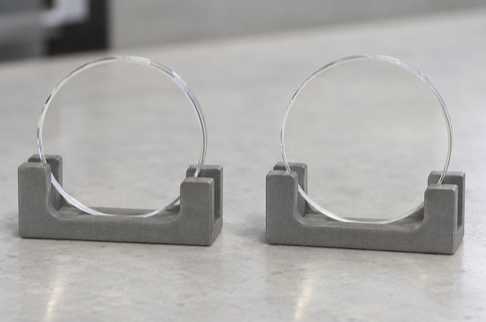
Sapphire and fused silica can both provide clear optical windows, yet their similar appearance conceals important material differences. Sapphire is a crystal; fused silica is a glass. They differ in hardness, thermal behavior, and polarization response, and those differences can influence a medical optical instrument.
The useful comparison begins with the component’s job. A window exposed to frequent handling may emphasize surface durability. A polarization-sensitive imaging path may place more weight on optical isotropy. A component near a laser delivery region may need a careful thermal assessment.
There is no universal winner. A well-specified window uses the material whose properties suit the optical path, mounting, and service conditions. Understanding those requirements makes the comparison more useful than choosing whichever material sounds more advanced.
The structural difference matters
Sapphire is single-crystal aluminum oxide. Fused silica is an amorphous material composed primarily of silicon dioxide. It lacks the long-range crystalline order of crystalline quartz.
The terminology can be confusing because quartz glass is often used commercially for fused silica or fused quartz products. A buyer should confirm what a particular supplier means rather than treating every quartz description as the same material.
Optical fused silica also comes in grades with different absorption behavior. Technical guidance distinguishes ultraviolet and infrared grades and connects the choice to the wavelength band. A generic request for fused silica can therefore leave part of the optical requirement unresolved. [1]
For sapphire, crystal orientation can be an additional consideration. The need depends on the instrument’s polarization sensitivity and the directions in which light passes through the component.
Compare the properties that affect the design
| Design consideration | Sapphire | Fused silica |
| Material structure | Single-crystal aluminum oxide | Amorphous silicon dioxide glass |
| Surface durability | Higher hardness and scratch resistance | Lower hardness than sapphire |
| Polarization response | Intrinsically birefringent | Optically isotropic when unstressed |
| Thermal conductivity | Higher heat conduction | Lower heat conduction |
| Thermal expansion | Greater expansion than fused silica | Very low thermal expansion |
| Purchasing details | Orientation, grade, finish, mounting surfaces | Optical grade, absorption band, finish, mounting surfaces |
These comparisons describe material tendencies. They do not establish the performance of a finished window with a particular thickness, coating, or mount. Optical-window guidance treats material, thermal, and surface characteristics as separate selection factors for that reason. [2]
A purchasing comparison should therefore use equivalent component requirements. Comparing a polished coated sapphire part with an unfinished fused-silica blank says little about the relative cost of two usable windows.
Scratch resistance is useful but not decisive
Sapphire optical windows are attractive where high surface hardness serves the design. An exposed optical surface may encounter handling or contact that makes this property valuable.
Hardness does not make the component immune to mechanical damage. Edges can still chip, and unsuitable clamping can create fracture risk. The mounting design and edge treatment must suit the material and geometry.
Fused silica has lower hardness, but it may still satisfy an instrument whose optical surface is protected or whose handling conditions are controlled. Rejecting it solely because sapphire is harder can overlook the properties the measurement actually needs.
The engineering question is the expected exposure. If scratching is a credible service issue, define how the window is contacted and protected. If the part is enclosed, other optical requirements may have more influence on the decision.
Polarization can favor a different material
Sapphire’s birefringence can change the polarization state of transmitted light. The effect depends on orientation and optical geometry.
For ordinary illumination, this may be compatible with the instrument. For a system measuring polarization, it can become a specific design concern. A published polarization-enhanced laparoscopy prototype used a fused-silica window to avoid effects associated with a conventional sapphire component. [3]
That is a useful example of selection driven by the measurement rather than a general material ranking. The window material was changed because the optical method needed a particular behavior.
Fused silica can still show stress-induced birefringence when mechanical or thermal conditions introduce stress. Choosing an intrinsically isotropic glass consequently does not remove the need to assess the installed component. The mounting process must preserve the behavior the optical design assumes.
Thermal conductivity and expansion answer different questions
Sapphire conducts heat more readily than fused silica. Fused silica changes dimensions less with temperature. These are different characteristics, and either can matter depending on where the window sits in the instrument.
A design concerned with moving heat away from a local region may evaluate conductivity. A design concerned with dimensional changes and thermal mismatch may give more attention to expansion. The surrounding housing and contact interfaces affect both assessments.
Experimental work comparing quartz and sapphire chambers for infrared laser vessel sealing found that the material changed heat transfer within the studied arrangement. The result illustrates why an optical component near energy delivery may need more than a transmission check. [4]
The buyer should therefore provide the relevant temperature and exposure conditions when requesting a material review. A room-temperature optical comparison may leave an important part of the operating environment unaddressed.
Transmission must be checked for the actual grade
Both materials can transmit useful optical bands, but neither should be selected from visible appearance alone. The required wavelengths, thickness, and finished surfaces determine the meaningful transmission specification.
If the instrument uses illumination and detection at different wavelengths, specify both. If a coating is needed, distinguish the substrate transmission from the coated component’s performance. Coating behavior also depends on angle and polarization conditions.
The same discipline applies to replacement parts. A clear disc with matching dimensions may still have a different material grade or coating. Confirming those details is more useful than assuming the original specification can be reproduced by appearance.
For a design with a shoulder or locating surface, a sapphire step window is one geometry that can be reviewed. It should be compared with the required alternative geometry, rather than with a simple glass disc that does not perform the same mechanical task.
Work through two different selection situations
Consider a hypothetical polarization-sensitive imaging instrument with a protected optical window. The optical team may place a high priority on controlling polarization changes and may have relatively modest exposure to surface contact. In that situation, an appropriate fused-silica grade can merit evaluation even though sapphire offers greater hardness.
Now consider a different instrument with an exposed window subject to handling, where polarization behavior can be accommodated by the optical design. Sapphire’s surface durability may become more relevant. Its selection still needs a suitable edge treatment, support, and assessment of the service environment.
These situations illustrate why a comparison should begin with the requirements. They are not recommendations for particular clinical devices. The completed assemblies would need evaluation against their own optical and mechanical limits.
The same approach applies to cost. If one material needs a more complicated coating or mounting arrangement to meet the design, a lower blank price may not produce the lower component cost. Comparing the parts in the condition required for assembly gives a more useful commercial answer.
A buyer can make that comparison easier by issuing a common drawing and clearly identifying any material-dependent requirements. Suppliers can then review equivalent scopes instead of filling gaps in two differently worded requests.
Compare complete component offers
Stanford Advanced Materials (SAM) supplies sapphire and other optical crystal materials for medical equipment. Buyers can provide the wavelength band, clear aperture, dimensions, surface requirements, orientation where relevant, and mounting details for review.
Where a fused-silica alternative is being evaluated, identify the required optical grade explicitly. A refractories-grade silica product or a differently shaped optical component is not an equivalent window merely because the base chemical composition is similar.
The quotation comparison should also state which finishing and inspection steps are included. Dimensional tolerances, optical surfaces, coatings, and reporting can make a substantial difference to the scope of the offer.